
By the engineer who machines them. 9 years. 47,000+ cards shipped.
You pulled a credit card multitool out of a Kickstarter box, a gift wrap, or your own impulse checkout. You see bottle opener shapes, hex cutouts, a tiny ruler, maybe a saw edge — and a lot of question marks. This guide decodes every tool, shows real use cases, and flags the few mistakes that shorten a card's life.
TL;DR — the 30-second version
- Most cutouts are functional tools, not decoration. Hex slots fit standard M3–M10 nuts, wave edges open bottles, V-shapes strip wire.
- The right way to use it: apply force in-plane with the card, not bend it sideways. Titanium flexes. 440C steel doesn't — it snaps if abused.
- Sharp blades are not TSA-safe. Bladeless versions are. Check your specific model before flying.
- One card replaces 40–60 single-purpose tools in a drawer. That's the whole point of EDC: redundancy in your wallet, not in your junk drawer.
What is a credit card multitool?
A credit card multitool is a flat, wallet-sized piece of steel or titanium — roughly 86 × 54 mm (ISO/IEC 7810 ID-1 standard, same footprint as a Visa card) — with tool shapes CNC-machined or stamped into its surface. The idea: take 40–60 functions that would normally live in a drawer full of bottle openers, screwdriver bits, hex wrenches, rulers, and wire strippers, and collapse them into one 2 mm-thick card you never notice in your wallet.
The category started as pressed-steel novelties sold at Brookstone-style shops in the early 2000s. It matured into serious EDC gear around 2015, when Kickstarter creators started CNC-milling them from aerospace-grade Ti-6Al-4V titanium and hardening 440C stainless to 58–60 HRC. At MRF we've been shipping these since 2017 — 10 campaigns, ~4,000 backers, and a lot of warranty returns that taught us exactly which cutouts people actually use and which ones are just Instagram decoration.
The tool map — what every cutout actually does
Here's how to read your card. Specific layouts vary by model, but the function of each shape is standardized across the category.
1. Hex wrench cutouts (most common)
The series of hexagonal holes along one edge are metric wrench sizes — typically M3, M4, M5, M6, M8, and M10 (the numbers = bolt shaft diameter in mm, not the hex size). Use them the same way you'd use any wrench: slip the hex around a bolt head or nut, rotate the card as a lever. The card's long edge gives you ~86 mm of torque arm — plenty for loose bike stem bolts, furniture assembly, or a wobbly door handle.
Don't: try to break loose rusted or thread-locked bolts. The card is there for adjustment, not initial break. Use a real wrench first, then keep the card for touch-ups.
2. Bottle opener (wave edge)
The curved notch near one corner is a bottle cap lifter. Hook it under the crimped edge of a beer cap, pivot the far edge of the card downward against the bottle neck as a fulcrum. Opens glass bottles identically to a church key. Works on champagne-style wire cages too if you slip it under the twist.
3. Flat-head and Phillips screwdriver tips
Look for a narrow rectangular tongue (flat-head) and a cross-shaped notch (Phillips). These are designed for field adjustments — tightening a glasses screw, closing a battery compartment, adjusting a loose cabinet hinge. They're not replacements for a toolbox driver under real torque.
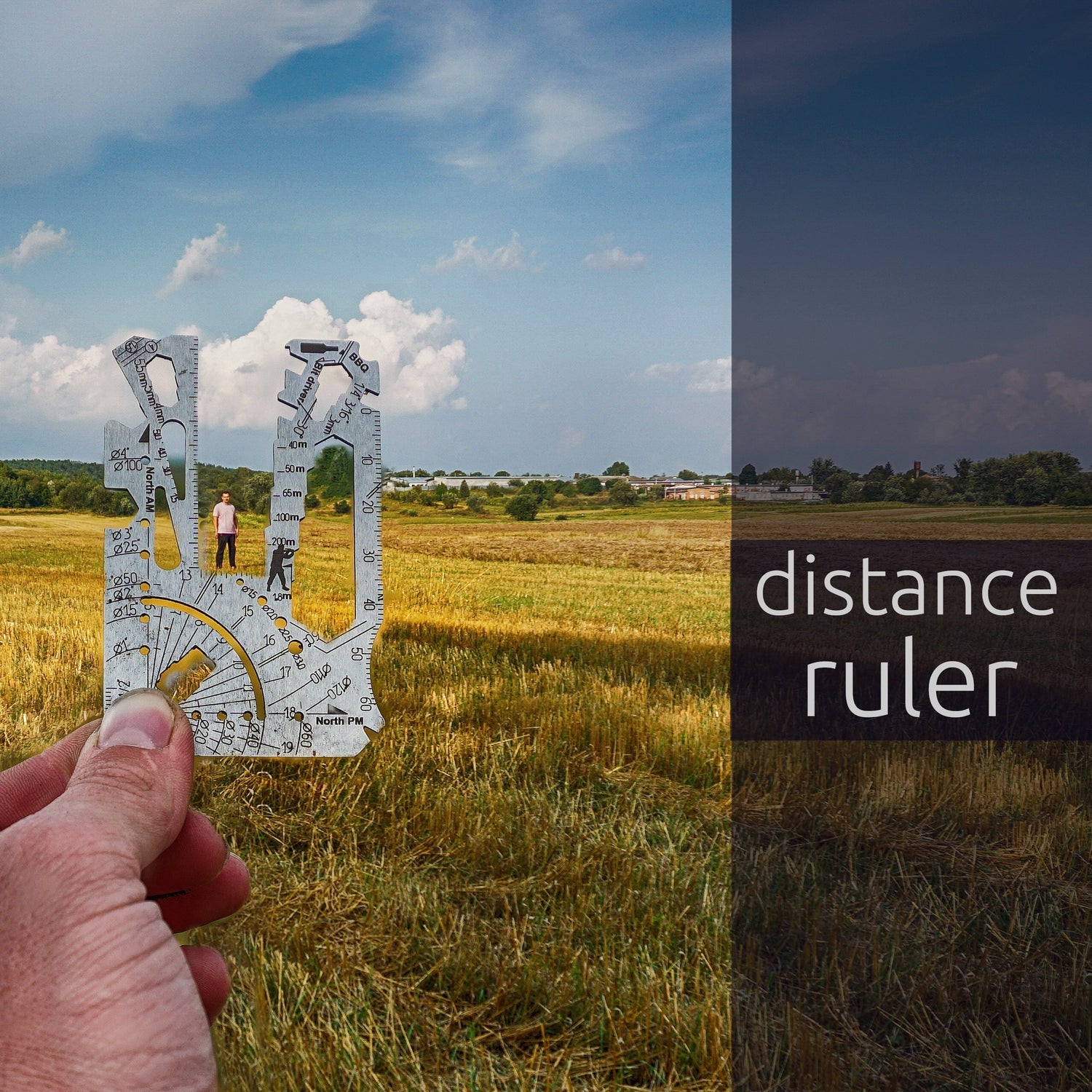
4. Ruler edge (mm and inch)
One or both long edges have millimeter markings. Standard card width is 54 mm, length 86 mm — so you always have a 5.4 cm and 8.6 cm reference, plus the engraved scale. Useful for drilling pilot-hole spacing, measuring screw lengths before a hardware-store run, or quick-sizing a phone case.
5. Wire stripper / cable gauge
A V-shaped notch with graduated teeth, usually labeled with AWG or metric gauges. Press the wire into the matching slot, rotate the card once, slide — insulation comes off cleanly. On the MRF Universal series we cut this at 22, 18, 14, and 10 AWG, which covers everything from headphone cable to lamp cord.
6. 1/4" hex bit holder
A square-shaped slot sized for standard hex driver bits (1/4", 6.35 mm). Drop in any screwdriver bit from your toolbox, and the card becomes a driver handle. This is the single most-used feature according to our warranty data — people love that it turns a $2 bit set into a pocket-sized driver.
7. Saw edge (optional, model-dependent)
On survival and outdoor-focused models, one edge has a row of aggressive teeth for cutting small branches, rope, or heavy zip-ties. Don't expect lumberjack performance — this is for emergencies, not firewood.
8. Cord cutter / letter opener
A sharp-angled notch (not an exposed blade) sized for slicing paracord, Amazon-box tape, shrink wrap, or an envelope. Blade-style cutters are what make a card TSA-restricted — if yours has an enclosed cord cutter only, it's usually flight-safe. Always verify with your carrier.
9. Sundial / protractor markings (specialty)
Some cards include engraved angle markings or sundial tables. These are real tools used by outdoor enthusiasts for rough navigation and solar time-of-day estimation without a phone. Niche, but legitimate.
10. Nail puller
A small hooked slot for pulling tacks, staples, or finish nails. Slide the nail head into the hook, use the card as a lever against the surface.
How to use it without breaking it
The #1 cause of returns in 9 years of shipping these isn't wear — it's users bending the card the wrong way. Here's how to keep one alive.
Apply force in the plane of the card. Titanium is flexible; 440C stainless steel is stiffer and hardened to HRC 58–60. Both can handle any in-plane torque you can generate with your hands. What they don't like: being twisted perpendicular to the card face — the same way you'd bend a coin. Don't use the card as a pry bar between two surfaces.
Match the tool to the job. Using the bottle opener for screwdriving, or the ruler edge for wire stripping, puts load on features not designed for it. Each cutout has one intended direction of use — the manufacturer's diagram shows it.
Keep it dry-ish. Titanium doesn't rust. 440C stainless is corrosion-resistant but not corrosion-proof — prolonged salt water exposure will eventually pit it. Wipe the card dry after kayaking or beach days.
Re-sharpen if needed. If your model has an exposed blade, it will dull. A basic whetstone or ceramic sharpener handles both titanium and 440C. Ten strokes per side, 20-degree angle, done.
Titanium vs. 440C steel — which material is yours?
Two materials dominate this category:
- Titanium (Ti-6Al-4V, "Grade 5") — the same alloy used in SpaceX Raptor turbopumps and medical implants. ~40% lighter than steel, completely non-magnetic, corrosion-proof, and it flexes instead of snapping. The trade-off: softer, so sharp edges dull faster. Feels premium in the hand.
- 440C hardened stainless steel — the same alloy as most premium kitchen knives. Harder (HRC 58–60), holds edges longer, slightly heavier. Will eventually show patina in salty environments but won't fail.
If you don't know which you have: check if a fridge magnet sticks. Titanium is non-magnetic; 440C is mildly magnetic. Weigh it — a titanium card at 86 × 54 × 2 mm weighs around 14–16 g, a steel one 22–24 g.
What about flying — is this TSA-safe?
Short version: bladeless credit card multitools are TSA-approved carry-on items. Bladed versions must go in checked luggage, because TSA prohibits any exposed blade regardless of length.
The MRF Universal 4.0 is designed bladeless specifically for flight — hex wrenches, bit driver, bottle opener, cord cutter (enclosed, not exposed), ruler. No blade, no problem. For a full breakdown of what flies and what doesn't, see our TSA rules for wallet multitools guide.
When to reach for the card
Nine years of customer stories distilled: people actually use these for
- Tightening the hex bolts on a bike stem mid-ride
- Opening bottles at a beach where nobody remembered a church key
- Assembling IKEA furniture when the included tool is lost
- Field-adjusting glasses, sunglass hinges, camera tripod screws
- Stripping a lamp cord during a late-night DIY
- Prying the battery cover off a TV remote
- Measuring a phone case before buying a replacement
- Opening Amazon packaging without hunting for scissors
It doesn't replace a toolbox. It replaces the decision to carry a toolbox. Every tool you don't need to think about is a tool you actually have when the moment hits.
Frequently asked questions
Can the card scratch my phone or credit cards in my wallet?
Edges are CNC-deburred on quality models — ours are tumbled smooth post-machining. Cheap stamped cards from unbranded sellers can have sharp flash; check the edges with your fingertip. If you feel burr, a few seconds on a nail file fixes it.
Do I need to carry separate hex bits?
Only if you want the 1/4" driver function. A 7-piece bit set fits in a coin pocket and costs $5. Most people carry 2–3 bits (Phillips #2, flat #4, Torx T15) and leave the rest at home.
How do I clean it?
Warm water, dish soap, soft toothbrush for the cutouts. Dry thoroughly. No acidic cleaners on titanium anodizing — they strip the color. Standard steel can handle anything kitchen-grade.
What's the warranty?
Manufacturer-dependent. At MRF, we replace any card that fails under normal use, indefinitely. Abuse-breakage (using it as a crowbar, running it over with a car) is your problem — but we've covered a surprising number of those too.
Will it set off metal detectors?
Yes, both titanium and steel versions. That's not a bug — airport screeners will still see it in X-ray. Just pull it out of your wallet for the tray like you would a phone.
The takeaway
A credit card multitool is not a replacement for a real toolbox. It's an answer to the question "what tool do I have when I need one and didn't plan ahead?" Used correctly — in-plane force, right tool for the job, kept dry — a quality titanium or 440C card lasts essentially forever. We have customers carrying 2017 first-generation MRF cards that still look identical to the day they shipped.
If you don't have one yet, or want to understand what a properly engineered version looks like, the Universal 4.0 is our current reference design: bladeless (flight-safe), 60+ tools, Ti-6Al-4V or 440C, made in Ukraine, shipping worldwide.
Featured in this article
Universal 4.0 Credit Card Multitool
Bladeless, TSA-safe, 60+ tools. Machined from aerospace-grade Ti-6Al-4V or 440C steel.
Shop Universal 4.0 →
0 comments